

Founders are very good at pushing forward.
New initiatives.
New ideas.
More activity.
But one of the most important leadership skills in a growing company is knowing when to pause and pay attention to the signals the business is sending you.
Sometimes those signals are obvious. Revenue slows. A product struggles to land. The team feels stretched.
But often they’re quieter than that.
Progress suddenly feels harder than it used to.
Energy is going in, but momentum isn’t quite appearing.
You find yourself solving the same problems again and again.
Nothing is obviously broken.
But something doesn’t feel quite right.
This is often the moment when the most valuable strategic conversations happen.
The pattern I often see with founders
Working with founders across different companies, I’ve noticed that when a growth strategy starts to wobble, the signals usually show up in one of three places.
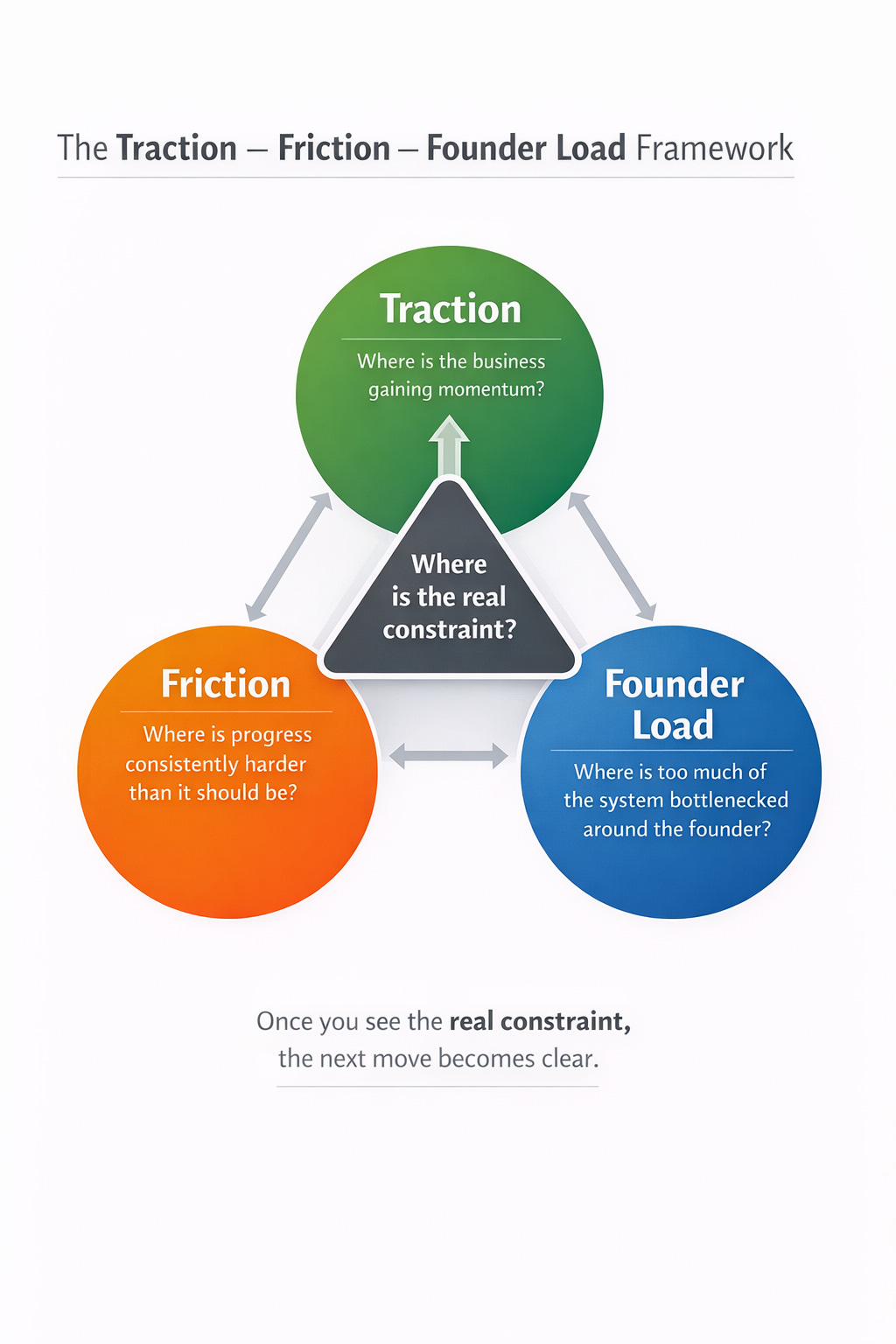
I think of this as the Traction–Friction–Founder Load framework.
It’s a simple way of diagnosing where the real constraint in a growing business might sit.
Traction – where the market is naturally pulling the business forward
Friction – where progress keeps stalling or absorbing too much energy
Founder Load – where too much of the system still depends on the founder
Most strategy issues appear here before they fully show up in the numbers.
Once you know where to look, the signals become surprisingly visible.
1. Traction
Where the market is already saying “yes”
Every growing company has pockets of momentum.
A particular customer segment converts faster.
A certain offer resonates more strongly.
One message suddenly lands.
Sometimes revenue starts appearing with less effort than expected.
These are traction signals.
The strategic question is simple but often uncomfortable:
Are we leaning hard enough into where the market is already saying yes?
Many founders unintentionally dilute traction by spreading their attention across too many initiatives.
When traction appears, the real opportunity is often focus and amplification.
2. Friction
Where progress feels consistently harder than it should
Every business experiences friction.
But persistent friction is usually a signal.
Sales cycles drag longer than expected.
Projects repeatedly slip.
Teams work hard but momentum feels slow.
Customers struggle to understand the offer.
When this happens, the instinct is often to push harder.
But sometimes the better question is:
Are we trying to force something that isn’t quite ready yet?
Friction can signal execution problems.
But just as often, it signals that something in the strategy needs adjusting - positioning, pricing, focus, or customer targeting.
3. Founder Load
Where the system still revolves around the founder
This is one of the most common constraints in scaling companies.
As businesses grow, the founder’s role has to evolve. But that evolution often lags behind the company.
You might notice signs like:
Decisions bottlenecking around you.
Customers expecting direct founder involvement.
Team members waiting for approval.
Strategic thinking squeezed out by operational work.
At some point the real constraint in the business is no longer the product, the market, or even funding.
It’s the founder.
The question then becomes:
Has the founder role evolved fast enough for the business we’re building?
The strategic questions worth asking
When something in a company feels slightly off, these are the questions I often explore with founders:
Where is the business naturally gaining traction right now?
Where does progress feel consistently harder than it should?
What initiatives are continuing simply because we said we would do them?
Where am I still the bottleneck in the system?
What is draining the team’s energy without producing real momentum?
If we simplified the business by 30%, what would we stop doing?
If everything worked perfectly this year, would we actually want the business we’re building?
These aren’t operational questions.
They’re diagnostic questions.
They help reveal where the real constraint might be.
A quick self-test
If you’re wondering whether your strategy is working as well as it could be, ask yourself:
Where is traction appearing faster than expected?
Where is friction slowing progress down?
Where am I still carrying too much of the system myself?
The answers are often more revealing than the metrics.
Because strategies usually start sending signals long before the numbers fully show them.
The founders who learn to notice those signals early are the ones who adjust sooner and build stronger companies as a result.
If you’d like a strategic sounding board to think through these signals in your own business, this is exactly the work I do with founders through Growth Strategy Sprints and Strategic Growth Advisory.
Sometimes the most valuable step in scaling a company isn’t pushing harder.
It’s stepping back just long enough to see what the business is trying to tell you.